Israel's Coalition Deadlock: Three Paths Forward After a Fragmented Election
With neither Netanyahu's bloc nor the opposition near a majority, analysts say the choice now comes down to an Arab-backed government neither side campaigned for, a unity coalition that would alienate each camp's base, or another trip to the polls.
2-MIN READ
By Israel Politics Post Staff·Published
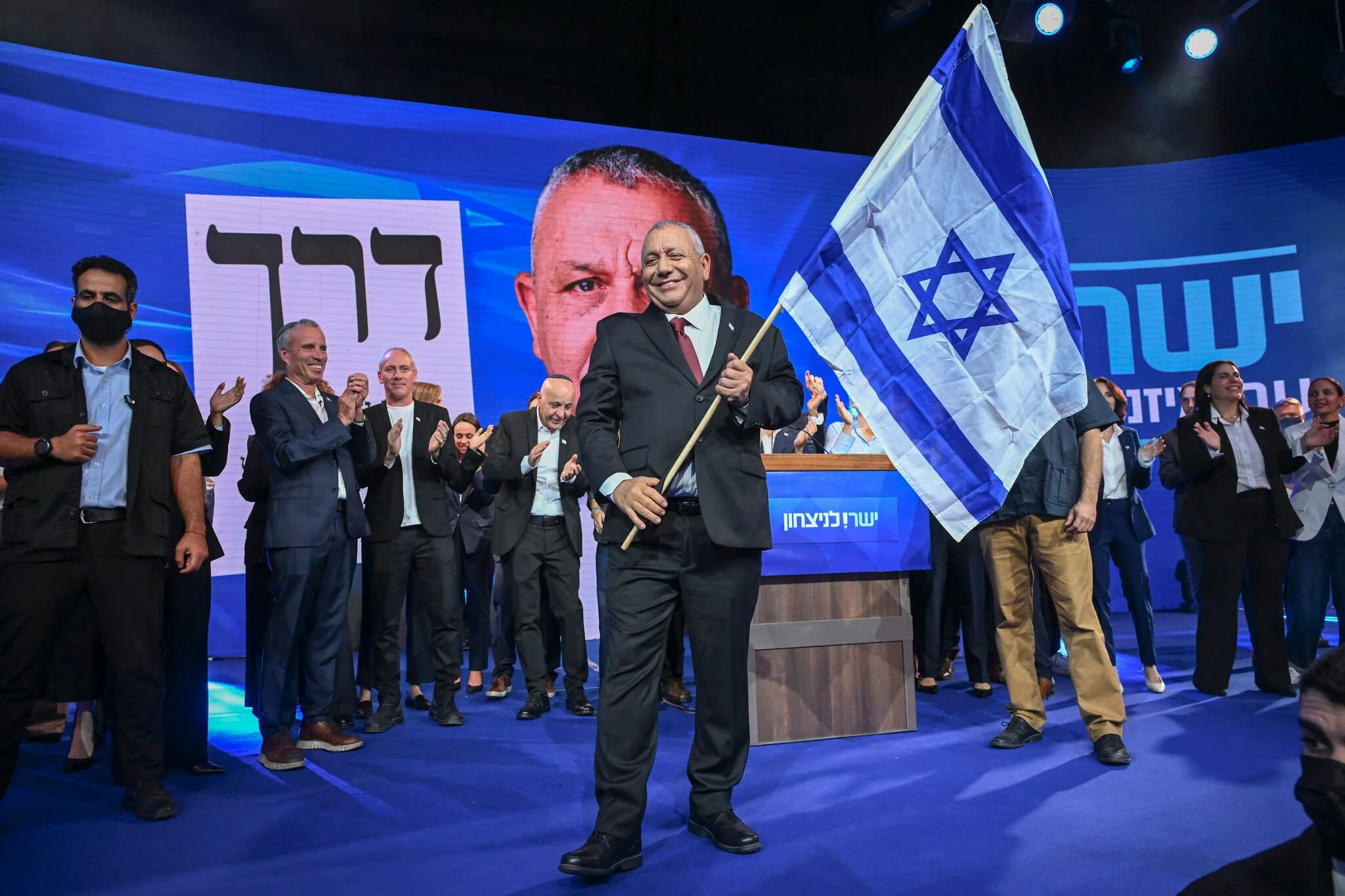
Yashar party chairman Gadi Eisenkot alongside members of his party at the party's election headquarters in Tel Aviv · Source: Avshalom Sassoni/Flash90, via The Times of Israel
With roughly 90% of votes counted, Israel's election has produced a fragmented Knesset in which neither Prime Minister Benjamin Netanyahu's bloc nor Gadi Eisenkot's opposition "change bloc" can reach a governing majority on its own, according to a report by The Times of Israel. Netanyahu's Likud took 26 seats, with his broader right-wing and ultra-Orthodox coalition reaching 53, eight short of the 61 needed. Eisenkot's Yashar party, with roughly 21 seats, led an opposition bloc totaling 48, while Arab-led parties won a combined record of 19 seats that could leave them as kingmakers.
Analysts have sketched three broad paths out of the deadlock. The first would see the opposition form a government with Arab parties' support, despite campaign promises to the contrary, either by including them directly in a coalition that could reach 67 seats, or by relying on their backing for key votes without formal participation. Yohanan Plesner of the Israel Democracy Institute said the option remains "mathematically and politically" viable but that Israeli public opinion is "deeply unprepared" for it, particularly in the aftermath of the October 7, 2023, Hamas attack. Yisrael Beytenu leader Avigdor Liberman has previously rejected relying on Arab parties, though some analysts believe pressure from Eisenkot could force a reconsideration if he becomes prime minister.
A second path would be a unity government spanning the political spectrum. Plesner suggested Netanyahu might prefer bringing in a single opposition party while keeping his existing far-right partners, while a broader "genuine" unity coalition could instead exclude some far-right or ultra-Orthodox factions in favor of a more centrist governing bloc. Either version risks alienating change-bloc voters who backed parties that campaigned explicitly on removing Netanyahu from power.
The third and, according to Hebrew University's Gideon Rahat, most likely path is another election, echoing the repeated election cycles of 2019 to 2021 before Netanyahu was briefly ousted. Analysts noted that serving as interim prime minister while a new vote is organized could work to Netanyahu's political advantage. Coalition talks, should they proceed, are expected to take "weeks and perhaps months," and President Isaac Herzog has urged politicians to keep an "open mind" and avoid forcing the country back to the polls.